
Everas / The Urolithin A guide
Urolithin A vs. NMN: which fits your goal?
Urolithin A focuses on mitochondrial recycling; NMN is a building block for NAD+, a molecule involved in metabolism. If your interest is mitochondrial maintenance, Urolithin A is the more directly relevant ingredient to explore. They address different biological processes.

Urolithin A
Studied for recycling worn-out mitochondria.
NMN
A precursor involved in NAD+ production.
Look at human outcomes
Mechanisms and biomarkers do not automatically predict how you will feel.
Mitochondrial upkeep or NAD+ metabolism?
Urolithin A and NMN are often grouped together as longevity supplements, but they are different compounds with different research questions. Urolithin A is associated with mitochondrial recycling. NMN, short for nicotinamide mononucleotide, is a precursor the body can use to make NAD+.
If you came here because both are described as “cellular energy” ingredients, this distinction is the place to start. A shared marketing category does not tell you whether they serve the same purpose or deliver the same experience.

Inside the cell
The mitochondrial connection
Mitochondria are involved in producing energy inside cells. Mitophagy is the process of recycling mitochondria, including damaged ones.
Compare their roles
| Question | Urolithin A | NMN |
|---|---|---|
| What is it? | A compound some gut microbes can produce | Nicotinamide mononucleotide |
| Main focus here | Mitophagy and mitochondrial maintenance | NAD+ metabolism |
| Plain-language idea | Recycling cell machinery | Providing a metabolic precursor |
| In Everas? | 500 mg per daily serving | Not included |
Different starting points
Compare the mechanism and the evidence.
Urolithin A and NMN address different biological processes. A clear product label helps you know what you are taking; it does not prove one compound is superior.
What people mean by mitochondrial maintenance
Mitochondria participate in cellular energy production. Mitophagy is one of the processes cells use to recycle them. Urolithin A’s connection to this process is the reason people explore it for muscle health and healthy aging.
Think of maintenance as the reason for your interest, rather than a sensation you can directly measure at home. Feeling different during a workout does not itself measure mitophagy. Your experience can still help you decide whether a purchase is worthwhile.

Everyday activity
For the things you enjoy doing.
Fitness is useful outside the gym, too. Everyday activities give you a practical way to think about the goals that matter to you.
What NMN research is asking
NAD+ is involved in cellular metabolism, and NMN is a precursor to it. Research asks whether supplementing NMN changes relevant measures and produces useful health or performance outcomes.
A 2024 systematic review included ten randomized trials and 437 participants. It reported that improvements in physical performance parameters were not statistically significant overall, with relatively short follow-up. Read the review.
This is a reason to ask which outcome was measured. A change in a biological marker is a different claim from reliably improving how a person feels, performs, or ages.
Which is the better fit for you?
If your interest is specifically mitochondrial recycling, Urolithin A is the more direct match to that topic. If you are exploring NAD+ precursors, NMN belongs to that conversation. Neither description establishes a universal winner for energy or healthy aging.
Choose a concrete question before choosing a product. Do you want to understand a particular mechanism, or are you trying to solve fatigue, improve exercise, or change a lab result? Those goals require different kinds of evidence.
What about taking both?
Some people discuss combining NMN and Urolithin A. Those accounts can describe what a routine felt like, but they cannot isolate each ingredient’s contribution. We do not have an Everas combination trial establishing an extra benefit.
A stack also adds cost and makes individual responses harder to interpret. Before adding another product, check the full ingredients and labeled directions with a clinician or pharmacist if you need individual advice. A complicated routine is not automatically a better one.
Compare products as carefully as ingredients
Once you decide which ingredient interests you, turn to the actual label. Look for the amount of that ingredient per serving, the number of units you take, the other ingredients, and testing that identifies the material and lot.
For a combination product, check whether each ingredient’s amount is stated individually. A single total blend weight makes it harder to compare with a product that clearly lists the amount of Urolithin A itself.
The Everas option
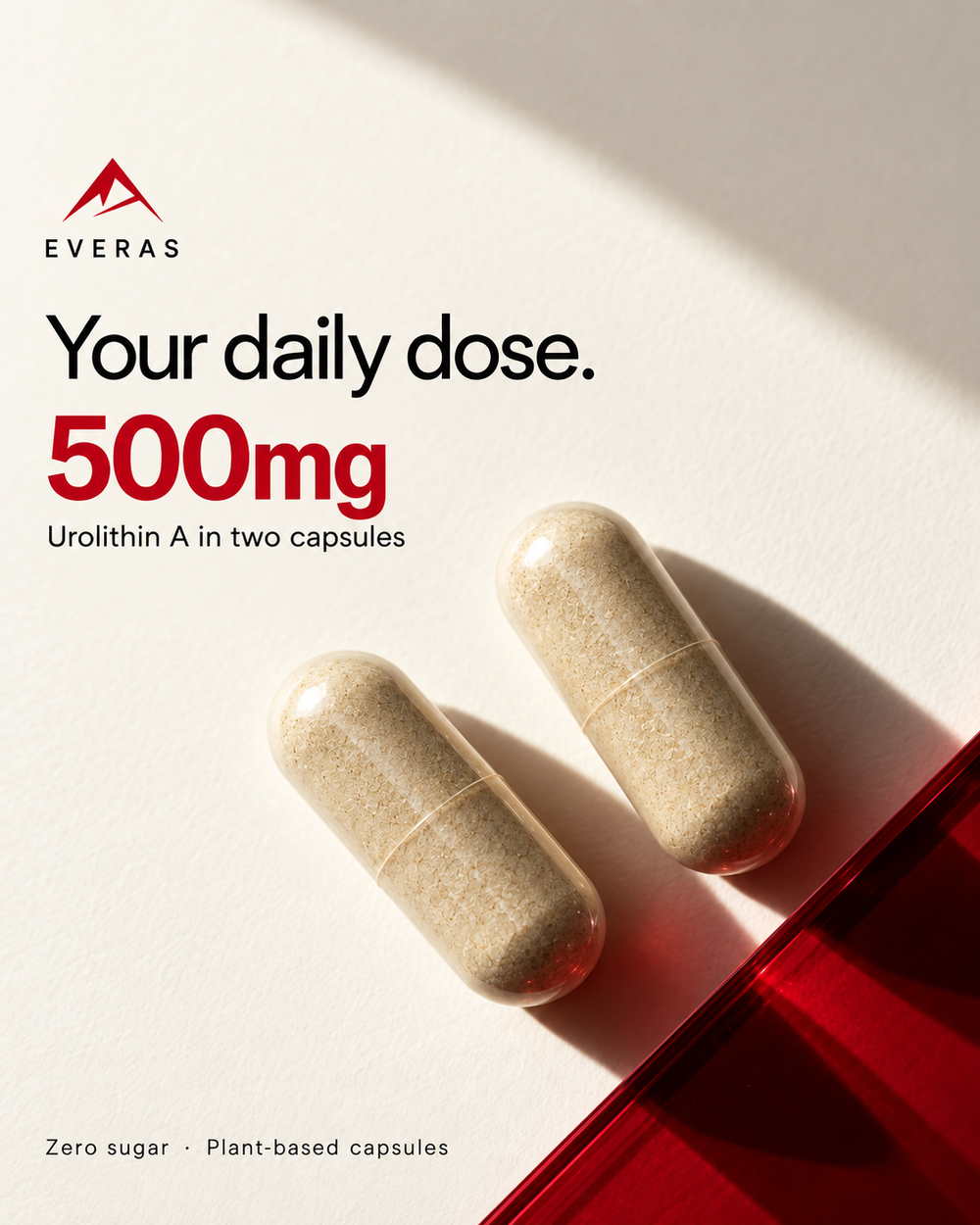
Everas keeps the Urolithin A choice simple: 500 mg in two capsules, zero sugar, and a plant-based capsule. It does not include NMN. There are 30 daily servings per pouch.
You can inspect both the ingredient purity report and the finished-capsule potency report. The latter measured 505.810 mg per two-capsule serving in tested lot EVR-2608-001. Read the testing details.
Start with a clear reason to choose Urolithin A
If mitochondrial maintenance is what brought you here, explore Everas as a direct Urolithin A routine with a stated serving and transparent product details.
Two capsules provide 500 mg of Urolithin A. A pouch contains 30 daily servings: $49.99 every 30 days on subscription or $59.99 as a one-time order, with free shipping. The 60-day money-back guarantee applies to both—even empty pouches qualify. See the formula, reviews, and purchase options →
Does a higher milligram amount make NMN or Urolithin A stronger?
Milligram amounts for different compounds are not a shared scale of effectiveness. Compare each ingredient with the evidence and directions relevant to that ingredient.