
Everas / The Urolithin A guide
Urolithin A vs. creatine: which should you choose?
For repeated bursts of strength and high-intensity exercise, creatine has the stronger established evidence. Urolithin A is worth exploring when your interest is mitochondrial maintenance. They have different roles, so choose around your goal.

Urolithin A
Studied for mitochondrial maintenance.
Creatine
Supports rapid energy availability during high-intensity efforts.
Match your goal
Different mechanisms call for different expectations.
Choose according to the job you want done
If your main goal is improving repeated, high-intensity exercise such as lifting or sprinting, creatine has the more established evidence for that job. If you are exploring mitochondrial maintenance, Urolithin A addresses a different biological process.
Both come up in conversations about muscles, but that does not make them interchangeable. Start with a specific goal, then choose an ingredient whose role matches it. “Muscle support” is too broad to settle the question by itself.

Beyond the workout
Make room for recovery.
The routine includes what happens between sessions: movement, rest, food and consistency.
The difference at a glance
| Question | Creatine | Urolithin A |
|---|---|---|
| Main role discussed here | Rapid energy availability for intense effort | Mitochondrial recycling and maintenance |
| Relevant goal | Repeated high-intensity performance | Interest in cellular upkeep |
| How to evaluate it | Training outcomes and suitable use | Mechanism, product details, and personal experience |
| Included in Everas? | No | Yes: 500 mg per two capsules |
Your supplement routine
A clear serving, a specific role.
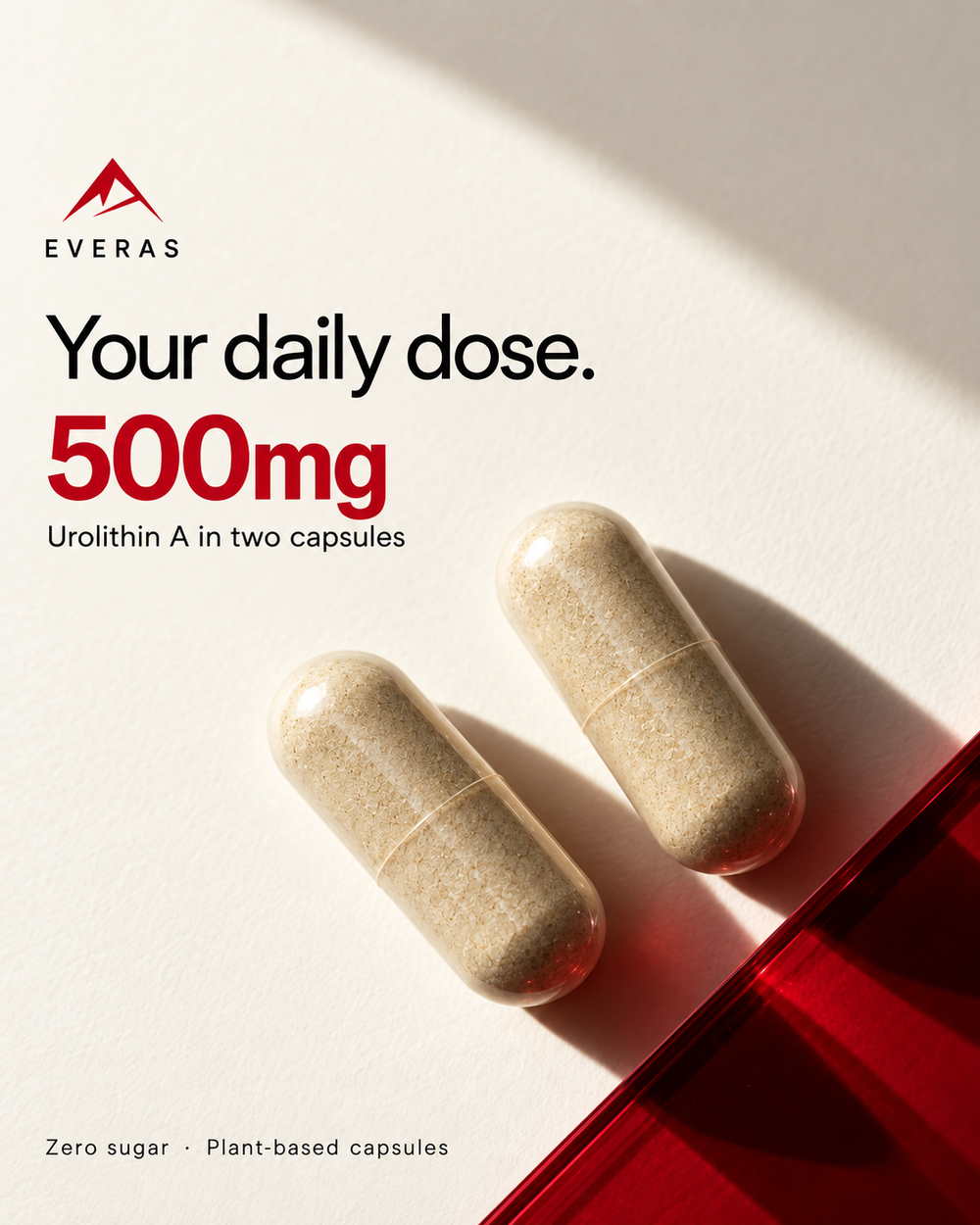
Two Everas capsules provide 500 mg of Urolithin A. Creatine is a different compound with a different evidence base; equal-looking amounts are not a useful comparison.
What creatine does
Creatine supports the phosphocreatine system, which helps replenish ATP during short, intense efforts. The NIH Office of Dietary Supplements identifies benefits for repeated bursts of high-intensity activity, while benefits for endurance exercise are less clear. Read the NIH exercise-supplement guide.
That makes the question more concrete. Someone trying to improve a series of heavy sets or sprints is asking a different question from someone interested in the long-term maintenance of the cell structures involved in energy production.

Compare what matters
Different formats. Different questions.
Read the ingredient, amount per serving and product-specific evidence. A capsule, softgel or scoop does not tell the whole story.
What Urolithin A brings to the discussion
Urolithin A is studied for mitophagy, the recycling of mitochondria. Muscle-cell research has observed increased activity in that process. Read the muscle-cell study.
Its appeal is cellular upkeep. You should not read that mechanism as evidence that it can replace creatine for a particular lifting outcome, or that the two ingredients have been shown equivalent in an Everas head-to-head trial.
A practical choice for three common goals
“I want to get more from repeated hard sets.” Creatine is the more directly established starting point for that exercise goal. Your training, nutrition, and recovery still determine much of your progress.
“I want to explore mitochondrial maintenance.” Urolithin A is the ingredient more directly associated with that research question. Evaluate the actual product, the serving, and whether your own experience makes it worthwhile.
“I want more energy for everything.” First define what feels difficult: a workout, afternoon fatigue, or recovery. A broad energy complaint does not identify which supplement, if any, is useful. Persistent or unexplained symptoms deserve medical attention.
Can you take both?
Different roles make the combination interesting, but they do not establish an additional benefit from taking both. We do not have a trial showing what an Everas-and-creatine routine adds compared with either alone.
If you are considering a combination, have the complete routine reviewed for your circumstances. Keep the labeled servings and note when each product starts. Avoid changing several things together if you want a clearer view of what agrees with you.
How to make your own comparison useful
For a training goal, follow a familiar workout and record a few relevant details: the load, repetitions, how the session felt, and recovery. Keep track of changes in sleep and training volume as well.
For a purchase decision, compare complete servings and the ongoing cost. You are not choosing the product with the biggest number on the front; you are choosing the routine that answers your question and fits your budget.
Where Everas fits
Everas is a direct Urolithin A product, not a creatine blend. It provides 500 mg per two-capsule serving, contains zero sugar, and uses a plant-based capsule. A pouch supplies 30 days.
The tested finished-capsule lot EVR-2608-001 measured 505.810 mg per serving. The separate ingredient report measured 99.733% purity. Inspect the laboratory results.
Choose Everas for the Urolithin A part of your routine
If mitochondrial upkeep is the reason you are exploring supplements, Everas gives you a defined serving and testing you can inspect. Keep the choice tied to that purpose.
Two capsules provide 500 mg of Urolithin A. A pouch contains 30 daily servings: $49.99 every 30 days on subscription or $59.99 as a one-time order, with free shipping. The 60-day money-back guarantee applies to both—even empty pouches qualify. See the formula, reviews, and purchase options →
Is Urolithin A a substitute for protein or training?
No. A Urolithin A capsule does not supply the protein, progressive training, sleep, or overall nutrition involved in building and maintaining muscle.