
Everas / The Urolithin A guide
Urolithin A vs. CoQ10: energy production and cellular upkeep
CoQ10 helps the body’s cellular energy-production machinery work. Urolithin A is studied for recycling damaged mitochondria. Energy production and mitochondrial upkeep are related, but they are different jobs. Here is how to think about the choice.

Urolithin A
Studied for mitochondrial maintenance through mitophagy.
CoQ10
Involved in mitochondrial energy transfer.
Different roles
The shared mitochondrial connection does not make these interchangeable.
Energy production and mitochondrial maintenance are different jobs
CoQ10 and Urolithin A both appear in discussions about cellular energy. CoQ10 participates in energy-production processes; Urolithin A is studied for mitochondrial recycling. That is the useful distinction when you are deciding what to explore.
You do not need to declare one ingredient the winner for every person. Start with why you are considering it, especially if a clinician recommended CoQ10 for a particular reason. A broadly similar marketing phrase is not a reason to substitute one product for another.

Inside the cell
The mitochondrial connection
Mitochondria are involved in producing energy inside cells. Mitophagy is the process of recycling mitochondria, including damaged ones.
How they compare
| Question | CoQ10 | Urolithin A |
|---|---|---|
| Biological role discussed here | Participation in cellular energy production | Mitochondrial recycling and upkeep |
| Source | Naturally present in the body; sold as a supplement | Produced by some gut microbes; supplied directly in supplements |
| In Everas? | No | Yes, 500 mg per daily serving |
| Decision to make | Why am I considering CoQ10? | Is mitochondrial maintenance my goal? |
Compare with purpose
Start with the question you want answered.
Understand the role of each compound before comparing products. Everas supplies Urolithin A; this article does not establish that it outperforms CoQ10.
What to know about CoQ10
CoQ10 occurs naturally in the body and has been studied for several health conditions. Its biological role does not mean that taking more will solve every energy complaint. NCCIH describes mixed or inconclusive findings for several proposed uses. Read NCCIH’s CoQ10 overview.
If CoQ10 came up in a clinical conversation, return to that specific reason. Ask what outcome is being targeted, how the plan will be assessed, and whether any of your medicines affect the decision.

Compare what matters
Different formats. Different questions.
Read the ingredient, amount per serving and product-specific evidence. A capsule, softgel or scoop does not tell the whole story.
What to know about Urolithin A
The interest in Urolithin A centers on cellular maintenance: recycling mitochondria through mitophagy. That makes it relevant to a different question from simply supplying a component used in energy production.
People exploring it often care about staying active, daily energy, and recovery. Those are understandable goals, but the purpose of a comparison is to distinguish the ingredients—not to turn a biological explanation into a promise that one will fix fatigue better than the other.
Which should you choose?
Choose according to the reason for taking it. For a clinician-directed CoQ10 plan, discuss that plan before changing it. For an interest in Urolithin A and mitochondrial upkeep, examine a direct Urolithin A product and its evidence.
If you are simply feeling unusually tired, adding either ingredient without understanding the cause may miss the real issue. Sleep, activity, medicines, and health conditions can all be relevant. Persistent or unexplained symptoms deserve an assessment.
Check interactions before building a combination
NCCIH notes that CoQ10 may interact with warfarin and insulin and may not be compatible with some cancer treatments. It also lists digestive upset and insomnia as possible mild side effects. Check the safety section.
There is no established added benefit for an Everas-and-CoQ10 routine. If you are considering both, bring the complete labels and your medication list to a pharmacist or clinician. Do not assume that different mechanisms make any combination suitable.
Compare the complete routine
Think beyond the front of the bottle. How many capsules would you take? How much would you spend every month? Can you identify what changed if you start several things together? A routine is easier to assess when its purpose is clear.
Keep a short record of what you take and why. If a product is part of a clinician’s plan, agree on how to review that plan. If it is a personal purchase trial, decide which everyday changes would make you want to continue.
Why consider Everas for Urolithin A?
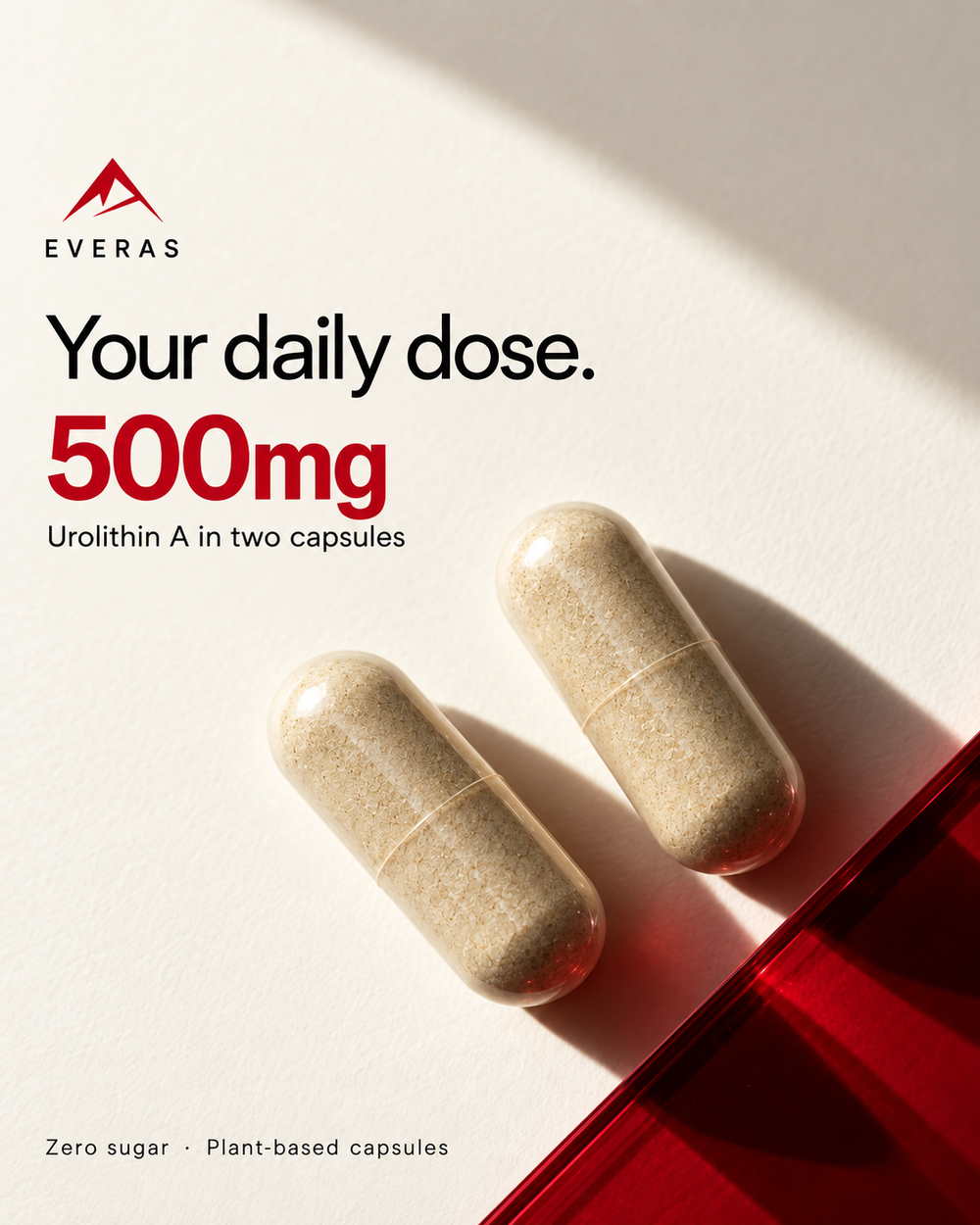
Everas provides Urolithin A directly in a simple capsule formula. Two capsules supply the labeled 500 mg serving; one pouch lasts 30 days. There is no CoQ10 in the formula, and it contains zero sugar.
The ingredient report measured 99.733% purity. A separate test of finished-capsule lot EVR-2608-001 measured 505.810 mg per two-capsule serving. See the laboratory reports.
Explore the Urolithin A option
If your interest is mitochondrial maintenance, Everas puts the serving, formula, testing, and purchase terms in view so you can make an informed choice.
Two capsules provide 500 mg of Urolithin A. A pouch contains 30 daily servings: $49.99 every 30 days on subscription or $59.99 as a one-time order, with free shipping. The 60-day money-back guarantee applies to both—even empty pouches qualify. See the formula, reviews, and purchase options →
Are Urolithin A and CoQ10 interchangeable?
No. They are different compounds. Do not replace a recommended product just because both appear in cellular-energy discussions.